Showing posts with label French History. Show all posts

Monday, November 12, 2007

15 November! The RED (wine) Letter Day for wine tourism in France!


Well....... for wine lovers, that is...........

and who can possibly NOT be a wine lover??


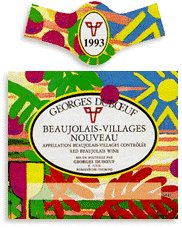
At one minute past midnight on the third Thursday of each November -- no! don't run for your calendar -- that is this coming Thursday, the 15th --- from little villages and towns like Romanèche-Thorins in the Bourgogne, over a million cases of Beaujolais Nouveau begin their journey through a sleeping France to Paris for immediate shipment to all parts of the world. Banners proclaim the good news: Le Beaujolais Nouveau est arrivé! "The New Beaujolais has arrived!" One of the most frivolous and animated rituals in the wine world has begun.

By the time it is over, over 65 million bottles, nearly half of the region's total annual production, will be distributed and drunk around the world. It has become one of the most important dates on the wine tourism calendar and the worldwide race to be the first to serve to this new wine of the harvest. In doing so, it has been carried by motorcycle, balloon, truck, helicopter, Concorde jet, elephant, runners and rickshaws to get it to its final destination. It is amazing to realize that just weeks before this wine was a cluster of grapes in a growers vineyard. But by an expeditious harvest, a rapid fermentation, and a speedy bottling, all is ready at the midnight hour.


Beaujolais Nouveau began as a local phenomenon in the local bars, cafes, and bistros of Beaujolais and Lyons. Each autumn the new Beaujolais would arrive with much fanfare. In pitchers filled from the growers' barrels, wine was drunk by an eager population. It was wine made fast to drink while the better Beaujolais was taking a more leisurely course. (Quite something in a country where the people have an abhorrence of fast food -- hence, of course, the fact that they so love to eat snails....) Eventually, the government stepped into regulate the sale of all this quickly transported, free-flowing wine.

In 1938 regulations and restrictions were put in place to restrict the Where, When, and How of all this carrying on. After the war years, in 1951, these regulations were revoked by the region's governing body — the Union Interprofessional des Vins de Beaujolais (UIVB)—and the Beaujolais Nouveau was officially recognized. The official release date was set for November 15th -- and once again that happens to be the date this year, in 2007!

Beaujolais Nouveau was officially born.

By this time, what was just a local tradition had gained so much popularity that the news of it reached Paris. And the race was launched.

It wasn't long thereafter that the word spilled out of France and around the world. In 1985, the date was again changed, this time to the third Thursday of November tying it to a weekend and making the celebration complete. But wherever the new Beaujolais went, importers had to agree not to sell it before midnight on the third Thursday of November.

Shall I see you at the local marchand on the place on Wednesday night -- or perhaps in Le Bugue where Julien de Sevignac in Avenue de la Liberation is waiting to treat you to la grande fete??


If not -- treat yourself to a visit to the great
  • Beaujolais Nouveau
  • site -- just the opening page is enough to get you 'into the spirit' of the occasion!


    Click on Link:

  • Chateau Lalinde : The perfect venue for your event

  • Relocation Orientation in France


  • Monday, October 29, 2007

    The Canal of Lalinde : A beautiful bit of history


    The Canal de Lalinde is probably one of the best little gems of the Dordogne River.

    Because the stretch of river that passes Lalinde is the only part of the Dordogne River which, due to a natural stone weir and three rapids, the Gratusse, the Gratussou and the Grand Thoret is too shallow for boat traffic -- and in particular the gabares flat bottomed boats that used to transport goods from the market in Sarlat down the river to Bergerac and further to Bordeaux, it was decided in 1840 to build this excellent engineering feat. By all accounts even back in 1852, 29,750 tonnes of goods passed along the canal between markets, by 1858 as much as 46,000 tonnes and a mere two years later, in 1860, no less than 200,000 tonnes!.

    The Canal stretches from Mausac to Tuilières with three locks along its 15 kilometers, which are still maintained even though no boat traffic goes slong the canal any longer. The lock at Tuilières comprise of a double set of three locks -- quite a remarkable sight! At Sainte-Capraize one can also see a special area where the canal crosses a small bridge.

    During the sixties, after a fatal accident at Port-de-Couze during the Tour de France, the canal was closed for boat traffic.

    Today the canal is a favourite spot for the fishermen - and women of the area -- apparently the fishing is very good, and any fisherman will tell you that in such exquisite surroundings, with its tunnel of Plane trees and soft golden reflections on the still water, the fishing is good even if the fist did not bite!
    From time to time, if you are lucky, you may also see a team of scullers use the canal for their training, and of course cyclists and walkers and joggers have long ago discovered the beauty of this spot.


    Related Links: Scenes on the Canal de Lalinde
    Fishing in the Dordogne
    Tuilières Barrage
    Gabares: Throw-away boats
    Fishing in France


    Click on Link:

  • Chateau Lalinde : The perfect venue for your event

  • Relocation Orientation in France


  • Monday, October 15, 2007

    Learning French: One phrase a Day


    Only today: THREE new useful phrases to keep on the tip of your tongue!


    Quoi de neuf ? What's new?

    Qu'est-ce que tu deviens ? What have you been up to?

    Quels temps nous vivons ! What times we live in!


    Photo: Carolyn Cole


  • Excellent Language School in the Dordogne:
    Aquitaine Langues


  • The best way to learn a language: Total immersion:
    Le Français Face à Face


  • Click on Link:

  • Chateau Lalinde : The perfect venue for your event

  • Relocation Orientation in France


  • Tuesday, September 11, 2007

    La Roque St-Christophe - suffers severe fire damage


    In the heart of the Vézère valley, between Les Eyzies-- which is regarded as the 'world capital' of Prehistory-- and Montignac -- where Lascaux II is found, is the magnificent troglodyte city of La Roque St-Christophe, a UNESCO World Heritage site and one of the 'musts' on my list for visitors to Chateau Lalinde to see.


    How ironic that this site, which has been a troglodyte city for the last 55 000 years -- right up to the 16th century, should now, in 2007, be closed to visitors. On 31 August a huge fire broke out -- apparently due to an electrical fault -- which burnt down the entire reception area -- a beautifully designed glass and timber structure which melded in so perfectly with the natural rock and ancient historical structures already in place.


    What a disappointment to arrive there yesterday with visitors and find that we could not climb up to the city and wander around in pre-history for a couple of fascinating and enjoyable hours. But the friendly official on site -- specifically there to apologise to visitor for the inconvenience and recommend other sites in the area to viist instead, informed us that the site will be open again in 2008 -- ready for the next summer season of tourists to the Dordogne area.

    Information: La Roque St-Christophe is a pre-historic troglodyte site dating from the Mousterian era, which has been lived in by successive generations of man. Its situation is very dramatic with good views, rising vertically 80m from the Vezère valley. The whole site is half a mile long and rises in five galleries dug out from the rock. The fascinating remains of some of the buildings can be seen – like the Church, as well as some medieval weaponry, while other parts of the site have been excellently reconstructed.
    Our recommendations: For children this is possibly the most interesting above ground pre-historic site – particularly for those who are not keen on either underground visits or families who prefer an unguided visit (leaflet provided with an English translation). It is possible to take a light-weight buggy around the site although care is needed in places.
    Location: Just off the D706 at Le Moustier, 10km NE of Les Eyzies.
    Free parking, small café and picnic tables at the site with lots of shade, a little pond -- and duck happy to receive a few crumbs.
    General info: Opening times – daily in peak season 10.00 -7.00.
    Tel: 05 53 50 70 45 other times.

    Related Article: The Birthplace of Man

    Click on Link:

  • Chateau Lalinde : The perfect venue for your event

  • Relocation Orientation in France


  • Wednesday, June 20, 2007

    The National Day of the Mills : Journee Nationale Des Moulins


    17 June 2007 once again saw the National Day of the Mills -- and in the Perigord Dordogne alone there were 21 beautiful ancient wind- and water flour mills to look at.


    I would have loved to have gone to see more, but only had time for four -- mills in various state of repair and restoration. I visited one wind mill -- that of Le Bournat at Le Bugue, which is in a perfect condition, being there all year round for visitors to come and admire. I then drove some distance through the most beautiful countryside, tine narrow lanes and thick oak forests. to finally arrive at Le Coux and Le Moulin de Ladiere which sits on the Le Boule stream. Here I was welcomed by a gorgeous farmyard of horses, chickens and a delightful Billy Goat --- and a charming young man who acted as a most informative guide, explaining the entire intricate workings of a water mill with enthusiasm and an obvious pride and pleasure. From there I continued on along the Dordogne river to Vezac where I visited the almost completely restored Moulin de L'Eveque which is situated on a tributary of the Dordogne, namely the Pontou. My last port of call was close to home, the mill of Lalinde -- which is in fact just outside Sauveboeuf, Le Moulin du Milieu a Sauveboeuf. This mill has been restored to its pristine original state and is in full working order -- a fascinating process to watch -- in particular as one realises that what you see is exactly what one would have seen 500 years ago! Several happy visitors walked away with soft white flour which had been milled right there in front of them.


    This is one industry which is nowhere near ready to hang up its boots!


    Click on Link:

  • Chateau Lalinde : The perfect venue for your event

  • Relocation Orientation in France


  • Tuesday, June 19, 2007

    Arts and Crafts -- and ancient traditions in the Dordogne

    On a misty Sunday in June in the Dordogne there can be few pleasures as special as going on a journey of discovery of the ancient and traditional arts and crafts of the countryside.

    Last Sunday was such a day -- and what a wonderful discovery it was! Not only seeing the old traditions kept alive and thriving, but discovering that it is the young people that are doing so.

    One would have expected these old crafts and traditions to be practised by the older generation whilst the youth are out and about and enjoying their electronic gadgets and toys and pastimes. But no! Whether it is the art of felt making, basket weaving, imprinting cloth with leaves from the walnut tree or platting wheat, the average age of all the artisans I saw on Sunday demonstrating their amazing skills, could not have exceeded 30! And wherever there was a wrinkled old man or woman showing us how it their specific art or craft should be done, there was always a young'un close by watching and learning and trying it out. There is such a variety of arts and crafts to learn -- and ideal reason to rent a chateau -- come to Chateau Lalinde during the summer, and organise a superb activity holiday for yourself and the family!

    And then, driving from beautiful Limeuil's hill top arts and crafts fair, to continue my day of discovery -- by visiting some of the many old mills in the Perigord, my surprise was even greater when I was welcomed by quite a few of the old mills by gorgeous young boys and girls who proudly demonstrated and explained the workings of a wind - or water mill to everyone who showed an interest. Some of these mills have been beautifully and meticulously restored, whilst others are in the process of - or waiting to be restored, and once again, it was not the older generation that shared their excitement with me, but the grand- and great grand children of the owners of the mills.


    Contact details for excellent artisans - and lessons - in the Dordogne:
    Basketry:
    Abdre Pineau
    24380 Lacropte
    Tel: 0553 067252

    Tiane et Marc Cattet
    24380 St Mayme de Peyerol
    Tel: 0553 045426
    www.laclairiereauxpaniers.com

    Daniel Breillat
    85240 Nieul sur l'Autise
    Tel: 0251524956
    LESSONS available

    Francois Desplanches
    24380 Lacropte
    0553 081522
    f.desplanches@wanadoo.fr

    Knitted Art, designs, clothing
    Me-tissages
    33640 Portets
    Tel: 0556 675950
    http://jetisse.googlepages.com
    anne.tisse@club-internet.fr

    Woven articles in natural home-spun and coloured wool
    Hilary Hunter
    24160 Excideuil
    Tel: 81748904

    Hat creations:

    Brigitte Paillet
    19560 Saint-Hilaire Peyroux
    Tel: 0684124342
    www.meschapeauxetmoi.com
    www.le-clapotis.net

    Annelie Petitqueux
    32170 Aux Aussat
    Tel: 0562 675315
    annelie@annafibre.com
    http://www.annafibre.com
    LESSONS Available

    Vegetable colouring and printing of fabrics
    84360 Oauris
    Tel: 0490084048
    www.couleurgarance.com
    LESSONS available


    Click on Link:

  • Chateau Lalinde : The perfect venue for your event

  • Relocation Orientation in France


  • Tuesday, June 05, 2007

    Women in Revolutionary France -- the 1789 revolution -- as well as the current one

    "The Lives and Times of Six Women in Revolutionary France." - could well be the book title of a book written in our own time. Only, the title would probably read "The lives and times of eight Women in Revolutionary France" -- as I reported on the seven women in Sarkozy's government -- and then we would have to add the eighth, namely Cecilia Sarkozy, who, I have no doubt, is going to leave her deep footprints in this era of this current revolution in France.

    In the New York Times this week, Judith Warner reviews a book about the women that marched to Versailles in October 1789.

    In 1791, Olympe de Gouges, a radical pamphleteer, published a response to the Declaration of the Rights of Man and the Citizen, which proclaimed France a constitutional monarchy and gave all men of property the right to vote. “Woman is born free and lives equal to man in her rights,” reads the first article of her Declaration of the Rights of Woman and the Female Citizen, which demanded full political rights and responsibilities for women. Since “woman has the right to mount the scaffold,” Gouges noted, “she must equally have the right to mount the rostrum.”

    The book, "Liberty", is subtitled "The Lives and Times of Six Women in Revolutionary France." and is by the author, Lucy Moore. (HarperCollins)
    The review:

    Gouge’s ideas were considered so laughable that they didn’t threaten — or even interest — the revolutionary powers of the day. She plastered the walls of Paris with her posters, the British historian Lucy Moore writes in her marvelous new book, “Liberty: The Lives and Times of Six Women in Revolutionary France,” but no one cared. “One sees them, stops for a second, and says to oneself, ‘Ah, c’est Olympe de Gouges,’ ” a government spy reported.

    And so it went with women’s efforts to include themselves in the effervescence of liberté, égalité and fraternité that swept France in the revolutionary period. France’s citoyennes were used in the streets of Paris as stooges and enforcers or idolized as keepers of the revolutionary home and heart, but when they drew attention to themselves as individuals rather than symbols, they were disdained, despised and sometimes, like Gouges, condemned to death. Women soon discovered, Moore writes, that “the ‘rank’ of citoyenne carried with it neither civic liberties nor political rights,” and “any woman who did have a voice in 18th-century France, from the queen down, was denounced for immorality.”

    As the revolution unfolded, female influence came to be associated with the corrupt court intrigues of the ancien régime. Robespierre, Moore observes, was a particular misogynist, hating the “flesh-and-blood” degradation he associated with womankind. In deference to — and, it seems, genuine belief in — the prevailing sentiments of the day, women like the liberal aristocrat Germaine de Staël and the civil servant’s wife Manon Roland, who kept the most influential salons in revolutionary Paris, took care to distance themselves from overt expressions of ambition or ownership of ideas.

    De Staël had a particular talent, a contemporary wrote, of declaiming for the benefit of her male guests “in strokes of fire the ideas they thought they held.” Roland, who lived, breathed and wrote about politics until her dying day, let it be known that she would rather chew off her fingers than publish her thoughts. Yet her attempts to ape respectable female modesty couldn’t save her; because of the influence she wielded in her husband’s world, she was called a monster by the press and sent to the guillotine. “Even though she was a mother, she sacrificed nature by trying to raise herself above it,” wrote one contemporary journalist. “The desire to be learned led her to forget the virtues of her sex.”

    De Staël, buttressed by her enormous wealth and privilege, avoided the guillotine but was denounced as an intriguer and a nymphomaniac. Most pitiably of all, Théroigne de Méricourt, a former courtesan who believed she could escape the bounds of her “ruined” life by joining forces with the friends of the revolution, was publicly whipped by a band of virtuous street women. Reviled as a whore, she descended into madness and spent the rest of her days chained to the walls of an asylum, raving about liberty, equality and royalists long after the revolution had ended.

    The women of the Paris street, represented here by the chocolate-maker Pauline Léon, were repudiated as “bloodthirsty Furies” and in many cases arrested. No woman with any kind of public standing was safe; even the “delectable” Thérésia de Fontenay, who, Moore suggests, probably took an initial interest in politics because it was fashionable to do so, emerged from the revolution “wearing diamond toe rings and anklets to hide — or perhaps to draw attention to — the scars on her feet and legs from the rat bites she had received in prison.”

    In Moore’s telling, only Juliette Récamier, the “icon” of womanhood in the Directory and early Napoleonic period, enjoyed renown but escaped the revolution more or less unscathed. In the public imagination, she was, apparently, a woman emptied of all bodily reality, living in what was said to be a white marriage — pure abstraction, pure projection, made flesh.

    The revolution, Moore shows, brought women many tributes to their maternal graces, their high-minded morals, their “natural” homebound virtues. Yet the veneration of Woman and hatred of real women were one and the same. “Ah!” Lucile Duplessis, later the wife of the revolutionary journalist Camille Desmoulins, wrote of the men in her world. “That they would worship us less and set us free!”


    It is going to be very interesting to see what roles such strong independent women as Cecilia Sarkozy, Rachida Dati, Penelope Fillon and 'MAM'will play in the new revolution that has started in France today -------- this might well be a space worth while watching!...........


    Click on Link:

  • Chateau Lalinde : The perfect venue for your event

  • Relocation Orientation in France


  • Saturday, June 02, 2007

    Celtic Festival in Rennes, Brittany

    Last night the annual Celtic Festival took place in Rennes, France, where the ancient and traditional sounds and colours of the Celts filled the night sky, as it did in the beginning of time.

    More than 400 musicians and dancers from Britain, Scotland, Ireland and even from l'Acadie -- the ancient 'province of France in North America/Canada (New-Scotland, New-Brunswick and the Island of Prince Edward)-- and of course, France, congregated in the capitol town of Brittany for an unsurpassed spectacle of light and sound.

    All the great names of Celtic music were there --- Alan Stivell on the Celtic harp, guitarist and greatest Breton cornemuse player, Dan Ar Braz, as well as the talented pianist Didier Squiban, to name but a few. British Airways even sponsored a pipe band from Scotland and the famous mariner group of Bagad de Lann-Bihoué also graced the planks. And no Celtic evening would be complete without the Irish river dance dancers, the bagadoù dancers from Auray, Locoal-Mendon, Pontivy, Lorient, Saint-Navaire, Pont l’Abbé, and Saint Evarzec.
    Even the biggest sceptic would have to agree that Celtic music is as alive and as well as it ever was and enjoyed all over the world!


    Click on Link:

  • Chateau Lalinde : The perfect venue for your event

  • Relocation Orientation in France


  • Friday, June 01, 2007

    The Foie Gras debate

    Agence France Presse reports that former James Bond star Roger Moore is calling for a ban on the sale of foie gras in Britain. The actor, who starred in films including "Live And Let Die" and "A View To A Kill", has written to lawmakers urging them to support calls for the move by People for the Ethical Treatment of Animals (PETA).
    "I wholeheartedly support this campaign and with your help, I believe that we will soon see an end to this brutal and inherently cruel 'delicacy,'" he wrote. The letter and an accompanying DVD, which highlight the "cruel" process used to produce foie gras, also call on legislators to sign a parliamentary motion supporting a ban which has so far been backed by 83 of them.
    The motion notes that, to produce the delicacy, "12 week old ducks and geese are restrained and grain is forced down the throat through a gavage pipe, a process that often results in physical injury." It adds that the process swells the birds' livers to up to 10 times their normal size causing "great pain" and calls on the government to ban the sale of foie gras in Britain.
    Earlier this month, nearly 9,000 members of the public signed a petition calling for a ban submitted by a local councillor from York, north England, to the website of Prime Minister Tony Blair's Downing Street office. In the United States, California and Chicago have already banned the sale of foie gras, while production is prohibited in countries including Germany and Italy.


    Spot the Difference:


    An 'adored' family pet dying a slow and painful death caused by the clogging up of arteries and too much weight pressure on joints and limbs and spine and the 'gavage' of a goose


    An obese child on a couch with bowls of junk food and geese on a foie gras farm roaming free in wide space and open air


    “One of the most common causes of overweight in children is overfeeding,” according to Dr. Philip Nader, a paediatrician and professor emeritus at the University of California at San Diego. Lead researcher Rachel Kimbro of the University of Wisconsin at Madison, USA, adds to this non sequitur: “These children are already disadvantaged (because often their families are poor,) and by age 3 they are on track for a lifetime of health problems related to obesity.”
    The MSNBC site reports that some 17 percent of U.S. youngsters are obese, and millions more are overweight. Recent statistics published in Britain were equally disturbing, and serious measures are planned to change an entire nation's bad eating and exercise habits. Obesity can lead to diabetes, high blood pressure and cholesterol, sleep problems and other disorders — and the problem starts early. Overweight preschoolers have a five times higher risk of being fat at age 12 than do lean preschoolers.

    I am loathe to use one negative to defend another. It solves nothing. But my question in this debate is why do people become so vehement in their fight for the plight of the fowls that are bred and raised to provide an important product -- important in the livelihood of many very hard-working farming communities - while back at home their children are more likely as not under-exercised and overweight because while their parents are out there fighting for the rights of ducks and geese, they are left at home to fend for themselves with take-away pizzas and MacDo double whopper hamburgers and French fries, packets of crisps and cola's. And let's not forget their pets which are equally overfed and under exercised and dying a slow death of malnutrition and weight related medical conditions.

    I will never defend any practice, for whatever reason, where animals of any kind are abused, caused pain or kept in inhumane conditions. Unfortunately there will always be those who will cause pain to animals. There is also no denying that there are cases where the birds are injured in the 'gavage' feeding process - just as all animals on all farms are exposed to possible injury. However, in the foie gras production business, each bird is literally worth its weight in gold, so it very much in the best interest of the farmer to treat them with the best and gentlest of care, to keep them in good health and the best possible environment, so rather fight for more inspections, closer monitoring, stricter licensing for foie gras producers -- and concentrate the animal-rights fighting energy for such things as bear baiting and travelling circuses.


    There are many reasons why celebrities, such as Roger Moore make sure they get easy and quick media attention by getting involved with animal rights movements -- but that is another story........Generally speaking, I realise that possibly the main reason that there is such an outcry against the production of foie gras, is firstly the fact that this is a luxury item -- it costs a lot of money for a small portion of foie gras (it is such a small micro-industry and the production process so labour intensive that the volume is of course limited) and therefore only a small handful of people can afford to ever eat it, and secondly the fact that it is consequently not a necessary or important food item for the consumer.


    The recorded historical background of Foie gras goes back to Egyptian times.
    The Egyptians observed that wild geese and ducks binge-eat - or 'force-feed' themselves before undertaking their seasonal migration in order to build up vast quantities of fat reserves in the live. They used this natural phenomenon, except that, when domesticating the fowls, they started inducing the natural over-feeding all year round. When, later, the Romans continued this practice, they went one further and used figs to fee the fowls -- from there the origin of the word foie (liver) -- from "ficandum" or fig. Jewish immigrants introduced geese to Alsace and served goose on their feast days as an alternative to the pork that was common in the area. For a long time these Jews of central Europe were the only ones to know the secrets of good foie gras.

    Today, 90% of France's foie gras is produced in the Perigord in southwest France, by far the largest foie gras-producing region in the world. The French consume 75% of the world production. Between 1992 and 2002, French production doubled, with 95% of the foie gras coming from ducks and 5% from geese.

    The primary objection that some people have to foie gras is the feeding method used to produce the product. The birds must be overfed in order to create the fattened liver. The liver enlarges over the course of the feeding process known as gavage. Claims have been made that the enlarged liver is "diseased". This is not true. In fact, it has been shown the liver shrinks back down to its normal size when a bird returns to lesser amounts of food intake. There is no evidence that the tube feeding method used to produce foie gras is inhumane. Being fed through a tube may sound unappealing to humans; however, it is important to remember that the oesophagus of a duck or goose is very different from ours. In nature, these birds are accustomed to storing fish and other foods in their oesophagus, sometimes for long periods of time. I have spent a lot of time with friends who raise geese and ducks to produce foie gras, and have seen how the birds crowds around her when it is feeding time, clamouring to be the first to be fed. I have also seen these same friends sit with tears streaming down their faces, killing their few hundred birds rather than confine them to an enclosed and cramped space when the law demanded it during the bird flu scare in France.

    The perception of foie gras as a luxury–and therefore wasteful product is another objection sometimes voiced by foie gras opponents. Contrary to what some people believe, almost every part of the mallard ducks that are raised for foie gras are used, more than any other bird raised for human consumption. The breasts, legs, wings, carcasses, tongues, feet, intestines, feathers and duck fat are all utilized. In fact, it is probably one of the few animals of which every possible part is used.


    Based on expertise borne of generations of experience, France has defined this business and set strict limits on what can be called foie gras in France. Very strict inspections are regularly conducted on all producing farms, vaccinations, food quality, environment quality and the general well-being of the animals are of utmost importance to keep the standards of the highest quality, as well as in the interests of the birds. For a country where most other animals do not enjoy too many humane concessions, the geese and ducks are the conspicuous exception. From the very old and highly respected firms to the many specialized local markets and the stays or cooking classes offered by small producers, foie gras in France is much more than business: it is a highly cultural aspect of life and society.

    Nutritional Facts
    Per Serving Size of 2 oz or 56g
    Calories 250
    Calories From Fat 220
    Total Fat 24g 37%
    Saturated Fat 7g 33%
    Foie gras is surprisingly low in bad fats and high in good fats. Many studies conducted by well-known and respected authorities have proven foie gras is as healthful as any other meat, although moderation is the key. We know that France consumes the largest portion of the world's foie gras production; yet, there are far fewer cardio-vascular diseases in France than in the USA, for instance, and the life expectancy is higher in France as well.

    • Foie gras cru - raw foie gras
    • Foie gras frais - fresh foie gras: This is usually purchased from delicatessens and is cooked in pots. It will keep for about one week in the refrigerator.
    • Foie gras mi-cuit: foie gras semi-cooked: This preparation is sold in cans and will keep for 3 months in the refrigerator once it is opened. It can be labelled in a variety of ways.
    • Foie gras de conserve - preserved foie gras which is sold in jars and preserved in its own fat, it will keep for years and improves like wine.

    Glossary:
    * Foie gras d'oie entier - whole goose foie gras
    * Foie gras de canard entier - whole duck foie gras
    * Foie gras au naturel - Pure whole livers
    * Bloc de foie gras or parfait de foie gras - liver compacted from small pieces and may include truffles
    * Pâté de foie d'oie - whole goose liver coated with forcemeat.

    Where should we rather start?


    Click on Link:

  • Chateau Lalinde : The perfect venue for your event

  • Relocation Orientation in France



  • The Perigord Noire Classic: discovering the beautiful Dordogne in a vintage car

    What a wonderful way to discover the beautiful Dordogne -- in a classic vintage car rally! The PERIGORD NOIR CLASSIC takes place from 7 to 9 September 2007, and this is what they say: "Between Vézère and Dordogne valleys, there is a magic and magnificent land, a charming destination where can be found some envied gems, and other to be discovered : the Périgord Noir.
    This country, situated in south-east of Dordogne department, has this name due to the darkness of its forest foliage, it is know to be the Human Land, the humanity birth-place. It became with the time an obliged walkway and it was and remain in great demand, for its culture richness, its hospitality, its humanism, and its famous gastronomy.
    There are few kinds to discover Périgord Noir, but one of the most original, matching past, culture and passion, is, without contest, with a classic car. It is the reason why we have created Périgord Noir Classic.
    The 2007 edition will make you discover the chateau valley, Beynac, les Milandes, Castelnaud, but also St Cirq la Popie, les grottes de Lacave, Collonges la Rouge and other beautifull things. 3 days of discovery and foie gras, for 2 persons : 1250 €


    Click on Link:

  • Chateau Lalinde : The perfect venue for your event

  • Relocation Orientation in France


  • The Norman Conquest in 4 minutes

    I have never ventured into the domain of film clips on my blog. A am never sure of what my readers are able to download or access, and even the number of photographs on the blog, I know, may slow down many systems and consequently stop people from coming here to read.
    But -- this little film clip is such a little gem, a four-minute clip that uses the Bayeaux Tapestry as a basis for an animated film of the events that led to the Norman Conquest. I simply had to share it with you. It should not be too difficult to view -- as it is in YouTube, so simply click on the URL and enjoy ---
    "The Norman Conquest for Dummies"


    Click on Link:

  • Chateau Lalinde : The perfect venue for your event

  • Relocation Orientation in France